Your website might be working against you right now, and you would have no way of knowing it just by looking at it.
This is different from the other tricks in this series. The AI Content Mill (SEO Tricks & Traps - AI Content Mills) and the Cloud PBN (SEO Tricks & Traps - Cloud PBNs) both involve someone deliberately building a scheme to game search rankings. Authority Leeching is different because the business being damaged usually did nothing wrong at all. Their website got compromised, and now it is quietly doing something they never authorized, while looking completely normal to anyone who visits it.
What Authority Leeching Is
Every website builds up a certain amount of trust with search engines over time. Age, consistent operation, legitimate content, and a track record of not being associated with spam all contribute to what is generally called domain authority. That trust is valuable. It is part of why an older, established site tends to rank better than a brand new one with identical content.
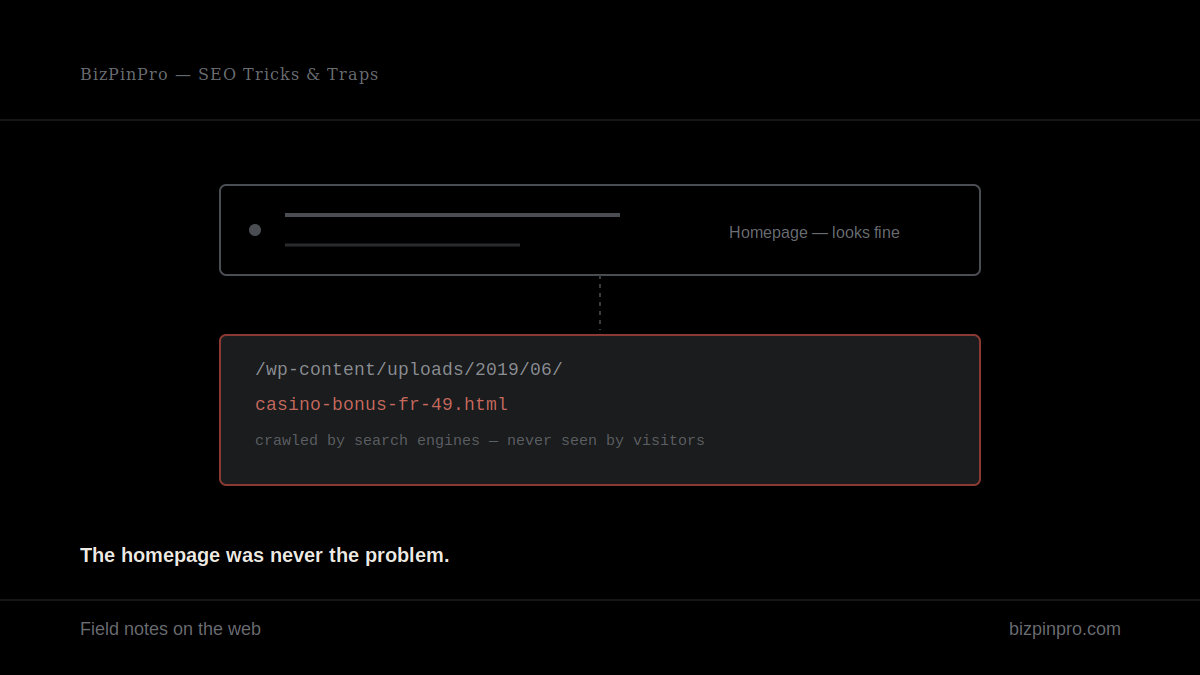
Authority Leeching is what happens when someone else exploits that trust without permission. An attacker finds a vulnerability in a website, often through an outdated plugin, an unpatched piece of software, or a weak point in the file structure, and uses that access to inject spam content or backlinks directly into the site. Not on the homepage where someone might notice. Usually buried in an uploads directory, a forgotten subfolder, or pages that were never meant to be publicly visible in the first place.
The injected content links out to whatever the attacker is trying to promote. Because the link is coming from your domain, and your domain has real, legitimate trust built up over time, that link carries weight. Your site's authority gets siphoned off and redirected toward someone else's agenda, entirely without your knowledge or consent.
How I Found This The First Time
I did not learn about Authority Leeching from a textbook. I found it by accident, auditing a limousine company's WordPress site early on.
The site looked completely normal from the outside. Good Google presence, functioning homepage, nothing that would make anyone suspicious. Then I ran a full crawl. Nearly five hundred pages came back. Forty nine of them were spam pages written in French, promoting online casinos, sitting invisibly in the site's structure where no normal visitor would ever find them.
Ten percent of every page on that website had been placed there by someone who was never authorized to touch it. Nobody who ran the business knew. The homepage still looked fine. Google, however, could see every single page, including the ones nobody else could.
That is the case that gave this problem its name. Full details, including the raw crawl data and redacted screenshots, are documented in In The Field 001, The French Connection.
Why It Is So Hard To Notice
This is the part that makes Authority Leeching genuinely dangerous rather than just annoying. The homepage still looks fine. The main pages a visitor would see still function normally. There is no obvious defacement, no warning banner, nothing that would make a business owner suspect anything is wrong.
The injected content is deliberately hidden from normal browsing. It lives in file paths nobody visits directly. A search engine crawler finds it because crawlers index everything, including paths a human visitor would never click into. The business owner has no reason to go looking there, and most never do.
The only way this typically gets discovered is through a backlink audit, examining exactly what domains are linking where, and finding spam domains pointed at paths on your own site that you never created and did not know existed.
Why Older, Neglected Sites Are The Most Vulnerable
Authority Leeching does not happen randomly. It happens to sites carrying Technical Debt, meaning outdated software, unpatched security vulnerabilities, and configurations that were correct years ago but have not been reviewed since. A site running an old version of its content management system with known, published vulnerabilities is not a hard target. Automated tools scan the internet constantly looking for exactly this kind of weakness, and they do not care how big or small the business behind the site is.
This connects directly to Set and Forget. A site that gets built once and never touched again is not just missing new features or falling behind on design trends. It is accumulating unpatched security holes the entire time nobody is paying attention, and those holes are exactly what makes Authority Leeching possible in the first place. That limousine company's site is a textbook example. Someone was adding content to it. Nobody was securing it.
What This Costs
The damage is not always about how the site behaves for a normal visitor. It is about what the site is quietly telling search engines. A domain associated with spam content, even content hidden deep in an obscure path, can suffer real consequences to its own rankings and trustworthiness. Google is actively working to identify and devalue this kind of manipulation, and a compromised site can get caught in that response even though the business itself did nothing wrong.
The business owner ends up paying twice. Once for whatever damage the compromise itself causes to search visibility, and again for the cost of finding and removing the injected content, closing the vulnerability that allowed it in, and rebuilding whatever trust was lost in the process.
How To Check
A basic backlink audit is the most direct way to find out if this has happened to you. Tools exist that show every domain currently linking to yours, and what specific path on your site each of those links points to. If you see spam domains, especially foreign or clearly irrelevant ones, pointing at file paths you do not recognize, that is the signal.
Keeping software updated matters just as much as checking after the fact. Every unpatched vulnerability sitting on a live site is an open door, and the longer it stays open, the more likely someone eventually walks through it.
The Foundation Connection
A Digital Foundation requires ongoing maintenance, not a one-time build. Authority Leeching is one of the clearest examples of what happens when that maintenance stops. The site was built correctly at some point. Then it was left alone, the software fell behind, a vulnerability opened up, and something moved in without anyone noticing.
You can also use our Domain Crawler, it was the tool that I used to see it for the first time.
Your website can be actively working against your own search visibility right now, and the only way to know is to go look.
Most business owners never do, because nothing on the surface ever gives them a reason to.