If your website runs on PHP, this one matters.
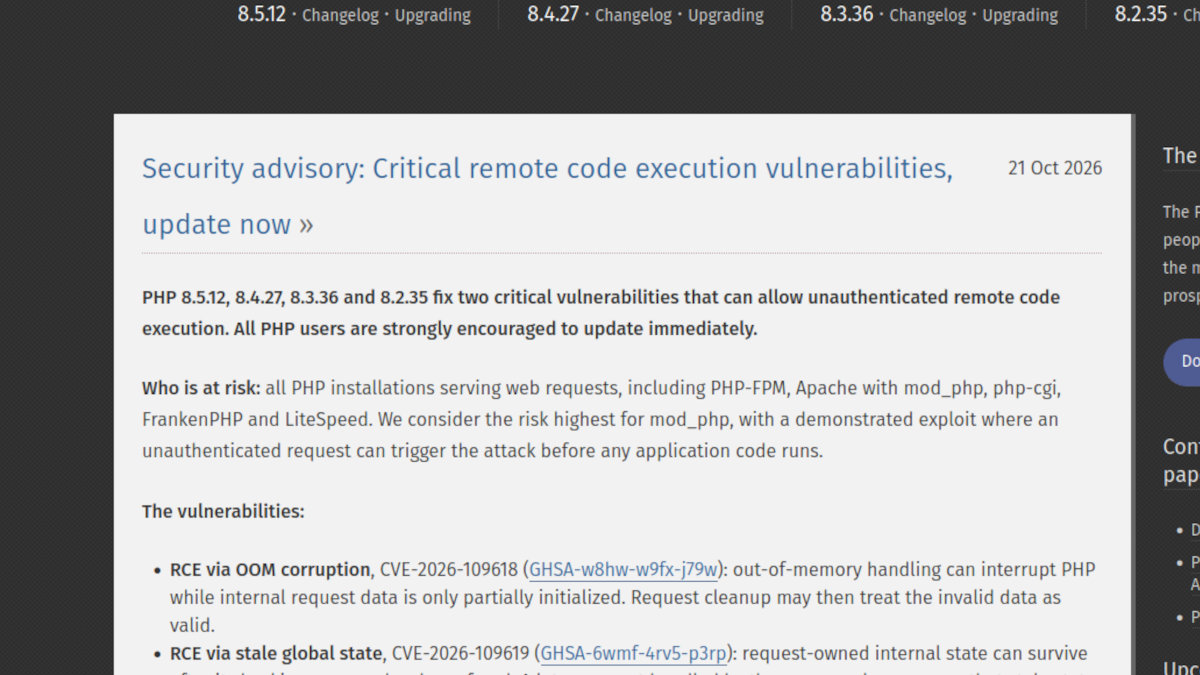
Security advisory: Critical remote code execution vulnerabilities, update now
If you are a BizPinPro client, the short version is this: every server I manage was patched late on October 21, the same day the fix was released.
What Happened
On October 21, 2026, the PHP team released fixes in versions 8.5.12, 8.4.27, 8.3.36 and 8.2.35 for two critical flaws. Both vulnerabilities, tracked as CVE-2026-109618 and CVE-2026-109619 and nicknamed PHP2Shell by researchers, carry a severity rating of 9.2 out of 10.
In plain terms, the flaws let an attacker without an account run code on a web server. No password, no login, no foothold needed. That is about as serious as it gets for a website.
This was not theoretical for long. watchTowr reported observing active exploitation attempts of both flaws on October 21. CISA urged organizations to patch immediately, noting the flaws affect all PHP installations serving web requests.
Why Updating Was The Only Real Fix
Some early alerts mentioned configuration changes as a stopgap. The PHP team was clear that those were not enough: only updating fully protects a server.
Older sites face a harder problem. End-of-life branches, PHP 8.1 and older, no longer receive updates from the PHP project. A site still running an old version of PHP has no official patch coming.
What I Did
When the fix was released, everyone running PHP tried to download it at once, and the download servers were overloaded. Rather than wait and try again by hand, I set up a process that kept retrying patiently until the files came through.
Every server I manage was updated late that same day.
Custom Code Did Not Make Me Immune
I build every site in custom PHP, with no WordPress and no plugins. That cuts down a lot of risk, but it did not matter here. This flaw was in PHP itself, the language underneath everything. A custom site and a WordPress site running the same version of PHP were equally exposed.
What protected my clients was not how the sites were built. It was that someone was watching and acted the day the fix came out.
If You Are Not A BizPinPro Client
Ask whoever hosts your website a simple question: has the server been updated to a patched version of PHP, and when? If they can give you a version number and a date, good. If they cannot answer, or do not know what you are talking about, that tells you something too.
If your site runs on an old, unsupported version of PHP, it needs more than a patch. It needs an upgrade.
The Foundation Connection
A Digital Foundation is not just how a site is built. It is whether anyone is watching it after launch. Paying for hosting means paying for someone to act when something like this happens, not weeks later, not when it becomes a headline, but the day the fix is available.
This week, that is exactly what it meant.


