When I first wrote about Upveyor, it did three things: uptime monitoring, traffic analytics, and contact form attribution. I said it was still growing.
Since August 26, it has picked up seventeen improvements. Every one of them runs on every site Upveyor watches, automatically. Nobody had to install anything or turn anything on. The full dated list lives on the Upveyor updates page. Here is what the changes mean for a business owner.
Upveyor Now Watches Four Things, Not Three
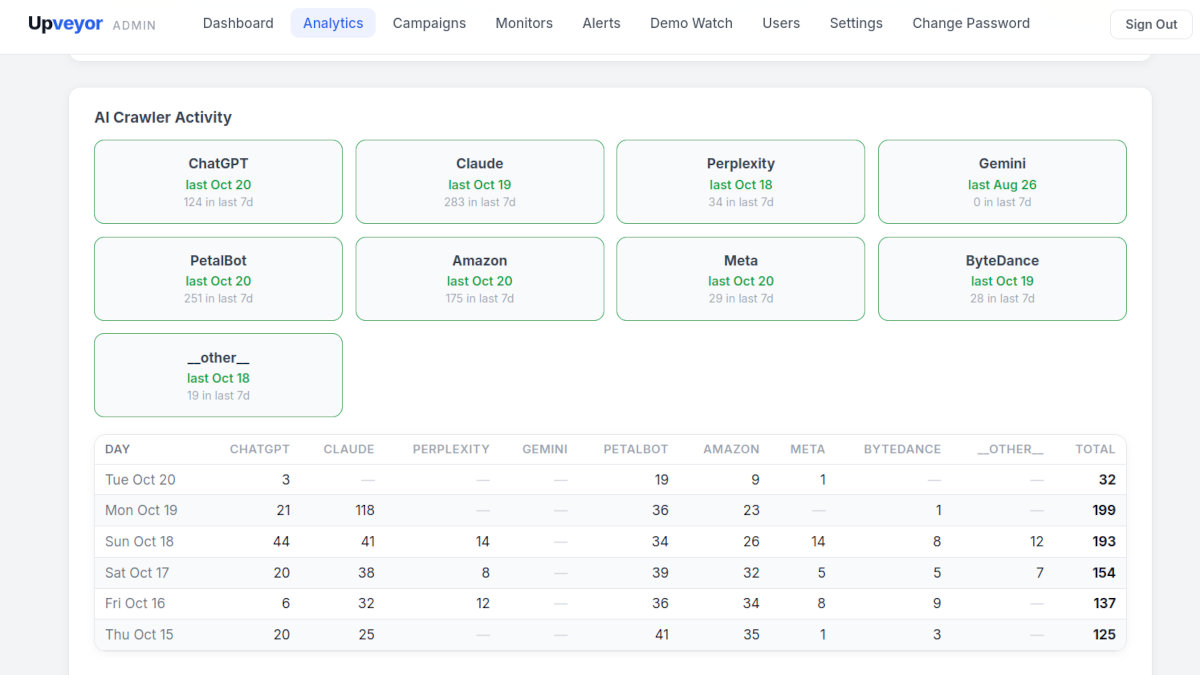
Uptime, analytics, and attribution are still the core. The fourth is AI visibility: whether ChatGPT, Claude, Perplexity, and Gemini can find your site at all.
AI crawlers never run the script that normal analytics depends on, so most tools never see them. Upveyor reads each hosted site's own server logs, recognizes the AI crawlers by name, and shows when each one last visited and how often it comes back. It also tracks when search engines and AI engines read your sitemap and your llms.txt file, which is often the earliest sign that they know your site exists.
There is also a free AI Readiness Check that anyone can run on any domain. It shows whether a site's robots.txt allows the major AI crawlers, and whether a live request from each one gets through, since a firewall can block a bot the robots.txt file allows.
Calls And Directions Count Now
For a restaurant or a shop, a tapped phone number is the lead, not a contact form. Until now, nothing counted it.
Upveyor now records every tap on a phone number, a directions link, a text message link, or an email address, with no changes to the site itself. Those show up on the traffic report as Calls, Directions, Texts, and Emails, and they carry into the monthly Digital Pulse report as people who reached out from the website.
The Numbers Got More Honest
Several of the changes were about making sure every number means what it says.
Crawler reads of sitemaps and llms.txt files were being counted as page views. They no longer are, and past counts were corrected. When a report says a page was viewed, a person viewed it.
The old Form Submissions number counted every press of the send button, including bots and failed attempts. It is now labeled Submit Attempts, and a new Delivered count shows only the messages that reached the inbox. If the two numbers do not match, something between the button and the inbox needs a look.
Form activity from phones was being dropped in some cases. That was fixed, so the counts are complete.
Fewer False Alarms, Faster Real Ones
One failed check used to trigger a down alert, even for a momentary network hiccup. Now a failed check gets confirmed within seconds before anyone is alerted. A real outage still alerts within the same minute. A blip stays quiet.
When a site does go down, a push notification reaches me within two minutes, through a notification server I run myself, alongside the email alert. Uptime checks also sample a random page from the sitemap instead of only the homepage, so a broken interior page gets caught too.
Reports Built For Local Businesses
The Geography panel now drills down from country to state to city, so a business can see that its visitors are in Christiansburg, Blacksburg, and Radford, not just somewhere in the United States.
Campaign links, like a QR code on a flyer or a link in a text blast, now have their own section instead of cluttering the list of referring websites.
The monthly Digital Pulse report every hosted client receives now draws its traffic numbers from Upveyor instead of Google Analytics. Nothing about a client's visitors passes through Google on the way to their report.
What Comes Next
Upveyor changes every week, and every change gets logged with a date. Advertising attribution is still on the list, tying ad spend to the traffic and leads it produces.
The Foundation Connection
A Digital Foundation needs someone watching it, and the watching has to be honest. Uptime that confirms before it alarms. Visitor counts that exclude bots. Leads that include the phone calls. AI visibility you can see instead of guess at.
Every one of these is already running on every site I manage.