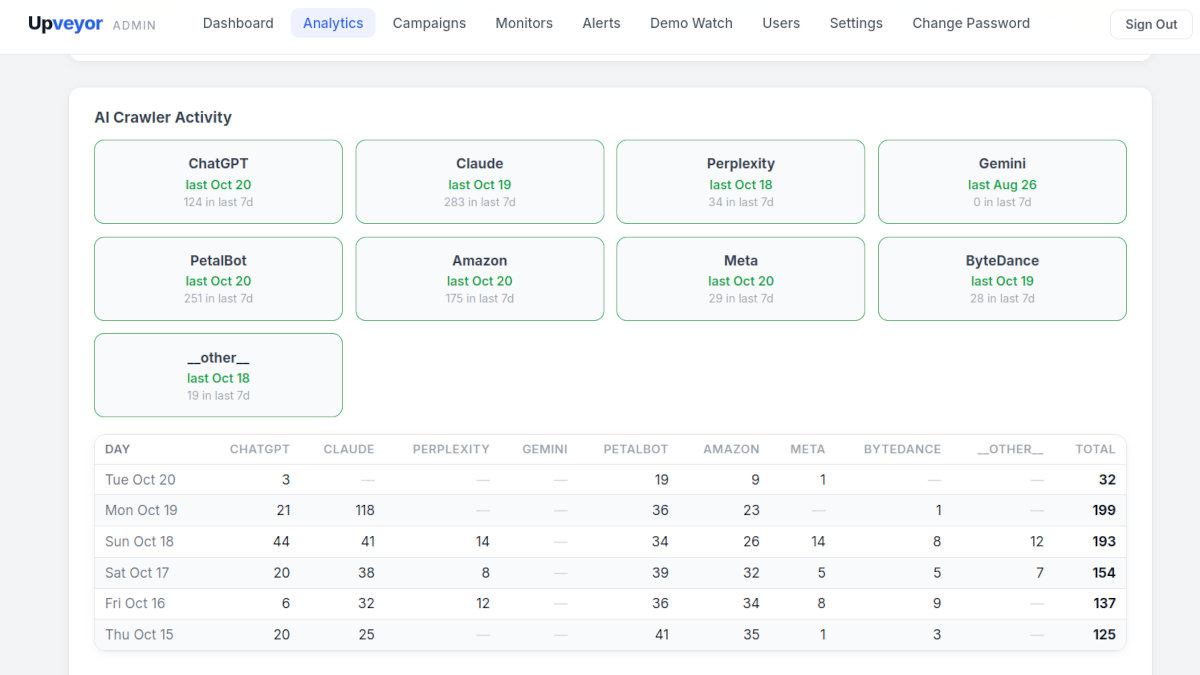
I built Upveyor (https://upveyor.com) because two separate problems needed solving, and neither one had a good answer sitting on a shelf somewhere.
Every website I manage runs on it now. Uptime monitoring, traffic analytics, and contact form attribution, all in one system, all running on infrastructure I own.
What It Does
Uptime monitoring checks every site on a fixed schedule, around the clock. When something goes down, I find out first. Not the client. Not a customer who tried to visit and got nothing. Me. That is the difference between active management and just hoping nothing breaks.
Traffic analytics tracks the fundamentals a business owner needs. Which pages get visited. How someone found the site, whether that was a search engine, a social link, or a direct visit. What device and browser they were using. None of it gets sent anywhere else. It stays on infrastructure I control, visible only to me and the client whose site it belongs to.
Contact form attribution ties a submitted form back to the browsing path that led to it. If someone fills out a contact form, Upveyor can show what pages they looked at before they reached out. That is not something Google Analytics hands you cleanly, and it is one of the most useful pieces of data a business owner can have when they are trying to understand what on their site is working.
Why I Built It Instead Of Using What Everyone Else Uses
Analytics was always the plan. I have written elsewhere about why I refuse to run Google Analytics on any site I manage, visitor data getting fed into an advertising company's ecosystem, a feature called Google Signals most business owners have never heard of, built specifically to connect behavior across other sites and devices. Upveyor's analytics exist because I wanted that data to stay with the business it belongs to, not get routed through a third party.
Uptime monitoring came from a completely different problem. Database connections were going cold between visitors on some of the sites I manage, meaning after a period of inactivity, the next visitor would hit a delay while the connection re-established itself. I could have paid for something like UptimeRobot to just watch for downtime from the outside. But the real fix wasn't watching from outside, it was solving the cold connection problem directly, and building my own monitoring system was the logical way to do both at once. Instead of a third party pinging my clients' sites from the outside with no visibility into what was happening underneath, I built something that understands the problem it's watching for.
What A Client Sees
Every client with hosting through BizPinPro gets access to a portal showing their own site's uptime history, response times, and traffic in plain language, not buried under menus the way Google Analytics tends to be. No separate account to set up. No dashboard to learn. It is already there, already running, from the day the site launches.
The Foundation Connection
Monitoring and analytics are part of a Digital Foundation the same way a properly configured domain or a verified Google Business Profile is. A site nobody is watching is a site that can fail silently for weeks before anyone notices, the same failure that let a Chinese manufacturing company sit on a client's expired domain while the vendor being paid to watch it did nothing.
Upveyor exists so that never happens on a site I manage. It started as a fix for a technical problem underneath my own sites. It became something worth building properly, and something I now trust more than anything I could have bought off the shelf.
Where It's Going
Upveyor is not finished. Advertising attribution is next, tying ad spend directly to the traffic and leads it produces, the same way contact form attribution already ties a submission back to the pages that led to it. The goal is a single system that shows a business owner exactly what is working across their entire digital presence, not fragments spread across three different logins they never check.
When it's done, Upveyor will be the most powerful tool BizPinPro offers its clients, not because it does the most things, but because everything it shows is theirs, built for their business specifically, and answerable to nobody but them.
Update, October 20, 2026: that advertising attribution is now built, along with sixteen other changes since this was written. The follow-up post, Upveyor: What Has Changed Since Launch, walks through what each one means for a business owner.