A message came through one of my client's contact forms recently. Not the first time, either. This was the second client to receive the exact same pitch from the same sender.
Hi, I'm from a company that helps businesses redesign their websites and improve their content so they look more polished and convert better. I took a quick look at your site and saw a few opportunities to improve the design and messaging, and I think now could be a great time to explore a new or refreshed website.
Cold outreach through a client's own contact form, offering to fix a website that does not need fixing, sent by someone whose job is apparently redesigning websites for other people.
I could not resist checking hers.
What The Audit Found
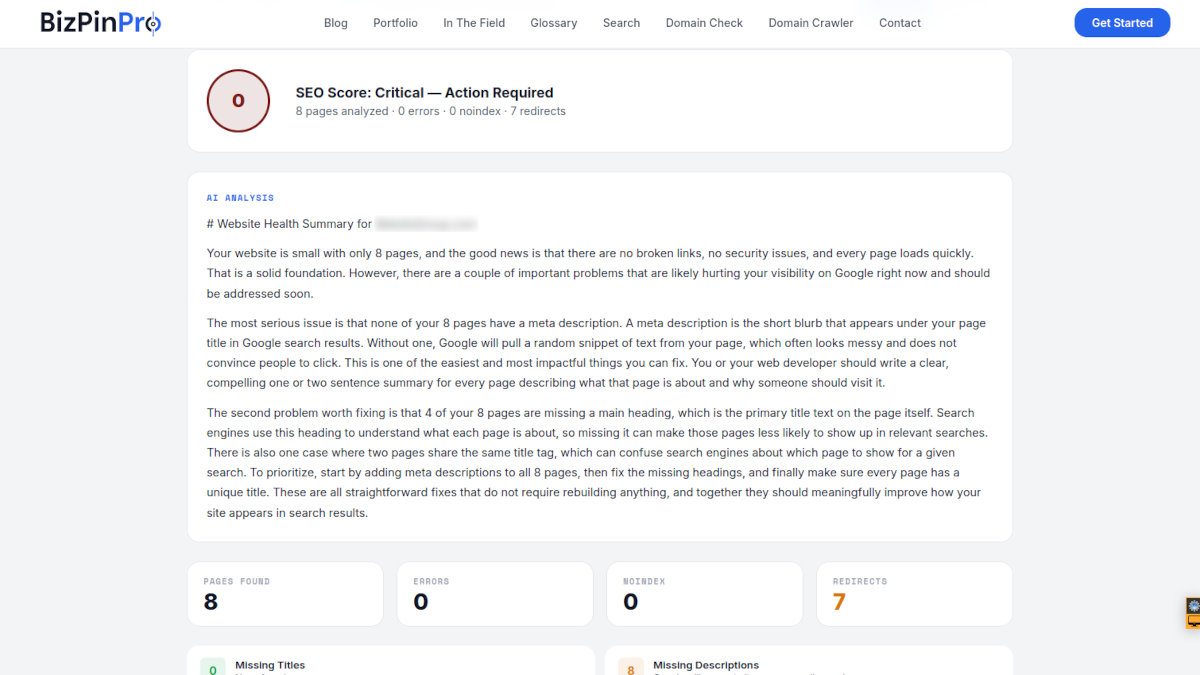
The audit certainly fit the pattern of what I call a Vending Machine Developer.
Her company's homepage has no meta description. No schema markup of any kind, meaning Google has no machine readable information about what the business is, where it operates, or how to reach it.
Twenty five images on the homepage. Zero of them have alt text. That is not just a missed SEO opportunity. It is an accessibility failure under WCAG 2.1 AA, the standard that legal accessibility requirements actually reference. A visitor using a screen reader gets nothing from any of those twenty five images. Neither does anyone browsing with images disabled on a slow connection. A company selling website improvements to other businesses has built a homepage that is functionally invisible to anyone who cannot see it.
The text to content ratio on the page is low, meaning the actual page is mostly code and structure with comparatively little substance underneath it. The site is built on a page builder platform, which tends to generate exactly that kind of Code Bloat by default.
This is not a business struggling to be found. This is a business offering to improve other people's polish and messaging while their own homepage has none of the technical fundamentals that make a site visible or usable in the first place.
This Is Not New
I have written about this before. The insider who called a freight carrier's site fine while his own six page website was missing every meta description and misspelled the word received on the thank you page (link). The GoHighLevel agencies selling bundled websites nobody maintains (link). The pattern is not that these people are incompetent at everything because they are good at selling smoke and mirrors. The problem is they are selling a service they have not actually applied to themselves.
Cold outreach works because most business owners cannot audit a claim like this. Someone says your website has problems and could convert better, and there is no easy way for the average person to check whether the person saying it actually knows what they are talking about.
I can check, and I really love checking.
Every time I have checked, the pattern holds.
What This Costs
Beyond the annoyance of an unsolicited pitch landing in a client's inbox, this created a real operational problem. Contact forms exist so real customers can reach real businesses. When they get used as a delivery mechanism for cold sales outreach, every legitimate lead request has to be filtered against an increasing volume of noise.
This happened enough times that I built an AI driven filtering layer into my own mail system specifically to catch and separate this kind of submission before it reaches a client's inbox. Not because one message was catastrophic, but because the pattern was going to keep repeating, and every client I manage deserves a contact form that actually delivers customers instead of solicitations.
That is not a small addition. It is now a permanent part of how BizPinPro protects the businesses it manages.
The Foundation Connection
A contact form is part of a business's Digital Foundation the same way a Google Business Profile or a properly configured domain is. It has to do the one job it exists to do, connect real customers to a real business, without becoming an open channel for anyone with a sales pitch and a script.
The irony of this particular message is hard to overstate. Someone offering to fix a stranger's polish and messaging sent that offer through a channel that exists for actual customers, from a website that has never had its own basic technical foundation addressed.
Check the site before you trust the pitch.
In this case, and in most cases like it, the site tells you everything the pitch will not.


