Dry Van
Fifty three foot trailers for palletized and floor loaded freight, with swing and roll doors available for tight dock situations.
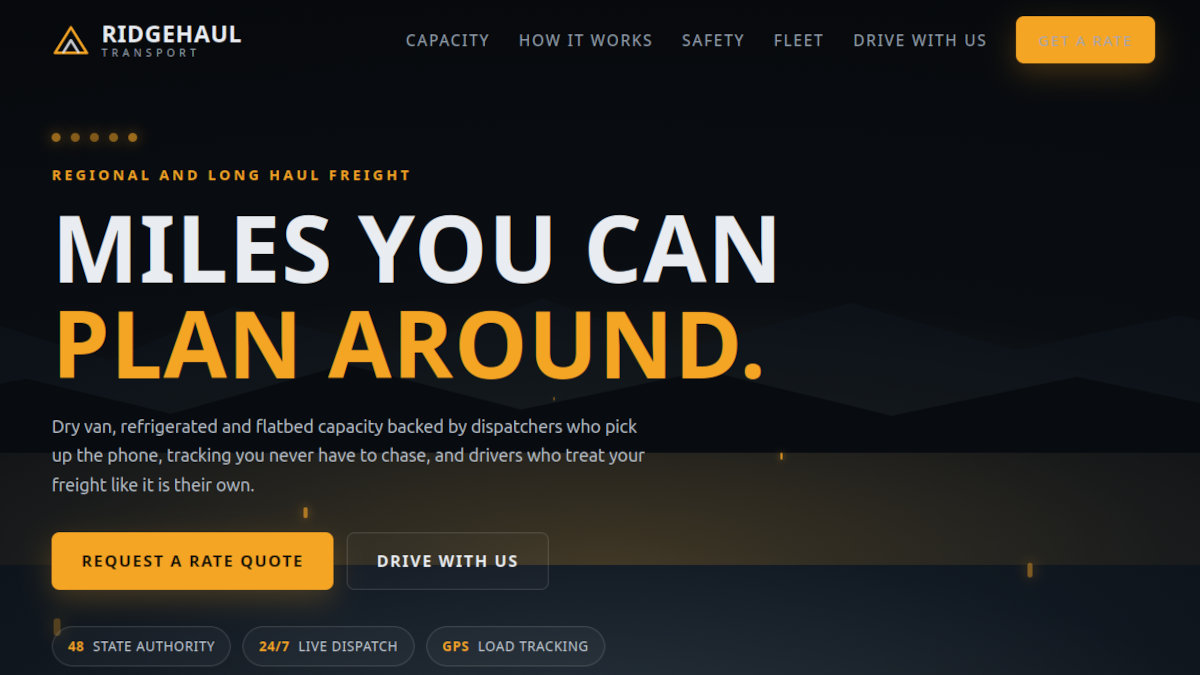
Regional and long haul freight
Dry van, refrigerated and flatbed capacity backed by dispatchers who pick up the phone, tracking you never have to chase, and drivers who treat your freight like it is their own.
What we haul
One carrier, one point of contact, and equipment matched to the freight instead of whatever happens to be empty.
Fifty three foot trailers for palletized and floor loaded freight, with swing and roll doors available for tight dock situations.
Temperature controlled trailers with continuous monitoring and download ready reefer logs for every temperature sensitive run.
Tarps, chains, straps and coil racks on board. Securement handled to FMCSA cargo standards before the wheels ever turn.
Team capable service for freight that cannot wait on a standard transit. Quoted, covered and rolling the same business day.
Recurring freight assigned to committed equipment and the same drivers, so your receivers see a familiar truck every week.
When a lane falls outside our own fleet, we place it with a vetted partner carrier and stay on the load until it delivers.
How a load moves
You should never have to wonder where your freight is or who to ask. Here is what working with us looks like from first call to signed delivery receipt.
Send the lane, weight, equipment and pickup window. A firm rate comes back, usually within the hour.
The load is assigned to a driver and a truck, and you get the details before it arrives at your dock.
Live GPS tracking, electronic logs and check calls at every milestone, without you asking for them.
Signed proof of delivery goes out the same day, along with any accessorial detail, clearly itemized.
Safety and compliance
A clean safety profile is not a certificate on a wall. It is hiring standards, inspection discipline, and hours of service that get enforced instead of tolerated. That is what keeps your freight moving and your brand off the shoulder of the interstate.
The equipment
Breakdowns are a service failure with extra steps. Our maintenance intervals are set by the calendar and the odometer, not by whether something is already making noise.
Now hiring CDL A drivers
We would rather run a truck a little less hard and keep the driver for ten years. If you have a clean record, a real work ethic and you are tired of being a truck number, come talk to us.
What shippers say
"We stopped chasing check calls the week we started using them. If something changes on the road, I hear it from their dispatcher before my customer hears it from me."
"Reefer freight is unforgiving and they know it. Temperature logs come back without me having to request them, and the trailers show up clean and pre cooled."
"Tarped steel, tight delivery window, first time working with them. The driver had it secured properly and made the appointment with time to spare."
Get moving
Tell us what is moving, where it is going and when it needs to be there. A dispatcher reviews every request personally, and you get a real answer from a real person instead of an automated reply.
Behind the scenes
A carrier is not a local business. Nobody searches "trucking company near me" and picks the closest one. Shippers and brokers check authority, insurance, equipment and lanes; drivers check home time and pay. So the search work on this site is about authority and recruiting, not the map, and the markup is shaped for that. Every item below is built into a real BizPinPro site for a business like this one. Click any of them to see the real piece and what it does for the owner.
Schema.org markup is a block of data in the page head, written in Google's own vocabulary, that says plainly what the business is. Schema.org has no type for a freight carrier (it has shops, dealers and movers, none of which fit), so Ridgehaul is typed as a business with the specifics carried by the fields: the USDOT and MC numbers as identifiers, the area served as the whole country rather than a town, the six equipment and service types listed one by one, and a dispatch contact marked as answered around the clock.
The home base keeps its town so the business still exists somewhere real, but there is no attempt to win a local map pack. A carrier that marks itself up like a corner shop confuses Google about what it is.
What it does for the owner: when a broker or a safety department looks the company up, Google already knows the operating authority and what it hauls, and the knowledge panel shows the operation instead of an empty card.
The schema a real Ridgehaul site would carry
{
  "@context": "https://schema.org",
  "@graph": [
    {
      "@type": "LocalBusiness",
      "@id": "https://ridgehaul.example/#business",
      "name": "Ridgehaul Transport",
      "url": "https://ridgehaul.example/",
      "description": "Asset-based freight carrier. Dry van, refrigerated and flatbed capacity with 48 state authority, live tracking and dispatch answered around the clock.",
      "address": {
        "@type": "PostalAddress",
        "addressLocality": "Dublin",
        "addressRegion": "VA",
        "addressCountry": "US"
      },
      "areaServed": {
        "@type": "Country",
        "name": "United States"
      },
      "identifier": [
        {
          "@type": "PropertyValue",
          "propertyID": "USDOT",
          "value": "1234567"
        },
        {
          "@type": "PropertyValue",
          "propertyID": "MC",
          "value": "987654"
        }
      ],
      "contactPoint": {
        "@type": "ContactPoint",
        "contactType": "dispatch",
        "telephone": "+15405550199",
        "hoursAvailable": "Mo-Su 00:00-23:59"
      },
      "hasOfferCatalog": {
        "@type": "OfferCatalog",
        "name": "Services",
        "itemListElement": [
          {
            "@type": "Offer",
            "itemOffered": {
              "@type": "Service",
              "name": "Dry Van"
            }
          },
          {
            "@type": "Offer",
            "itemOffered": {
              "@type": "Service",
              "name": "Refrigerated"
            }
          },
          {
            "@type": "Offer",
            "itemOffered": {
              "@type": "Service",
              "name": "Flatbed and Step Deck"
            }
          },
          {
            "@type": "Offer",
            "itemOffered": {
              "@type": "Service",
              "name": "Expedited"
            }
          },
          {
            "@type": "Offer",
            "itemOffered": {
              "@type": "Service",
              "name": "Dedicated Lanes"
            }
          },
          {
            "@type": "Offer",
            "itemOffered": {
              "@type": "Service",
              "name": "Logistics Support"
            }
          }
        ]
      }
    },
    {
      "@type": "WebSite",
      "@id": "https://ridgehaul.example/#website",
      "url": "https://ridgehaul.example/",
      "name": "Ridgehaul Transport",
      "publisher": {
        "@id": "https://ridgehaul.example/#business"
      }
    },
    {
      "@type": "WebPage",
      "@id": "https://ridgehaul.example/#webpage",
      "url": "https://ridgehaul.example/",
      "name": "Dry Van, Reefer and Flatbed Carrier, 48 States | Ridgehaul",
      "isPartOf": {
        "@id": "https://ridgehaul.example/#website"
      },
      "about": {
        "@id": "https://ridgehaul.example/#business"
      }
    }
  ]
}
No star rating is typed in on purpose. A rating written by hand is wrong the day the next review lands. It comes from the live Google profile or not at all.
The page already has a "Drive With Us" section. On a real site the openings on it are marked up as job postings in the same vocabulary, with the route type, home time, pay basis and the CDL required. Google reads that and lists the opening in its jobs panel, the one drivers see when they search "CDL jobs home weekly Virginia", with an apply button that lands on this site.
The posting carries a real end date, so a filled seat drops out of Google on its own instead of taking applications for a job that no longer exists.
What it does for the owner: recruiting without a job board fee. The posting reaches drivers who search Google and never visit the site, and it disappears by itself when the seat is filled.
A job posting on the drivers page
{
  "@context": "https://schema.org",
  "@type": "JobPosting",
  "title": "CDL-A Company Driver, Regional, Home Weekly",
  "description": "Dry van and reefer lanes in the Southeast and Mid-Atlantic. Late model tractors, paid detention, home every weekend.",
  "datePosted": "2026-09-28",
  "validThrough": "2026-12-31",
  "employmentType": "FULL_TIME",
  "hiringOrganization": {
    "@type": "Organization",
    "name": "Ridgehaul Transport",
    "sameAs": "https://ridgehaul.example/"
  },
  "jobLocation": {
    "@type": "Place",
    "address": {
      "@type": "PostalAddress",
      "addressLocality": "Dublin",
      "addressRegion": "VA",
      "addressCountry": "US"
    }
  },
  "baseSalary": {
    "@type": "MonetaryAmount",
    "currency": "USD",
    "value": {
      "@type": "QuantitativeValue",
      "minValue": 0.62,
      "maxValue": 0.7,
      "unitText": "MILE"
    }
  },
  "qualifications": "Class A CDL, 1 year verifiable OTR or regional experience, clean MVR"
}The title tag is the blue headline in a search result. It leads with what a customer types, not with the company name: "dry van", "reefer", "flatbed" and "48 states" first, Ridgehaul second. A broker searching for capacity types equipment and lanes, never a company name. 50 to 60 characters, one topic per page.
The meta description is the grey text under it. Written as a sentence a customer would click, 140 to 160 characters. It does not change ranking, but it changes who clicks.
The canonical tag tells Google which address is the real one. Without it, ridgehaul.example, www.ridgehaul.example, the same page with a trailing slash and the same page with a tracking code on the end can all count as separate pages, and the ranking is split four ways.
This demo page is set to noindex on purpose. Ridgehaul Transport is fictional, and a made-up business on BizPinPro's own domain would read as spam to Google. A client site is indexed from day one.
What the result would look like
The tags behind it
<title>Dry Van, Reefer and Flatbed Carrier, 48 States | Ridgehaul</title>
<meta name="description" content="Ridgehaul Transport moves dry van, refrigerated and flatbed freight with 48 state authority, live tracking and dispatch that answers around the clock. Send the lane, get a rate.">
<link rel="canonical" href="https://ridgehaul.example/">
When someone pastes the site into a Facebook group or texts it to a friend, the app builds a preview card. Without Open Graph tags it guesses: a random image from the page, or none, and the first sentence it finds. With them, the owner chooses the picture, the headline and the blurb once, and every share looks the same.
For a carrier the share that matters is a broker forwarding the link to a shipper, or a driver posting it in a trucking group with "home time that shows up on the calendar." The card has to show the iron and say what it hauls before anyone clicks.
What it does for the owner: freight and drivers both come by referral. The card is what gets forwarded, and it is the first impression of the operation.
The preview card
The tags behind it
<meta property="og:site_name" content="Ridgehaul Transport">
<meta property="og:title" content="Ridgehaul Transport | Dry Van, Reefer and Flatbed, 48 States">
<meta property="og:description" content="Asset-based carrier with 48 state authority, live tracking and dispatch that answers around the clock.">
<meta property="og:url" content="https://ridgehaul.example/">
<meta property="og:type" content="website">
<meta property="og:image" content="https://ridgehaul.example/includes/og-image.jpg">
<meta name="twitter:card" content="summary_large_image">
<meta name="twitter:title" content="Ridgehaul Transport | Dry Van, Reefer and Flatbed, 48 States">
<meta name="twitter:image" content="https://ridgehaul.example/includes/og-image.jpg">
A sitemap is the list of pages the site hands to Google so nothing has to be discovered by luck. On most sites it is a file somebody generated once and forgot. On a BizPinPro site sitemap.xml is generated by code every time it is requested, from the pages that exist right now. Add a page for a new lane or a new equipment type and it is in the sitemap the same minute, without anyone remembering to do anything.
Each entry carries a last-changed date that comes from the page's real change time, not today's date stamped on every line. A sitemap that says every page changed today, every day, teaches Google to ignore it.
What it does for the owner: new pages get found in days instead of weeks, and the site never hands Google a list that points at pages that no longer exist.
sitemap.xml, as generated
<?xml version="1.0" encoding="UTF-8"?>
<urlset xmlns="http://www.sitemaps.org/schemas/sitemap/0.9">
  <url>
    <loc>https://ridgehaul.example/</loc>
    <lastmod>2026-10-02</lastmod>
  </url>
  <url>
    <loc>https://ridgehaul.example/capacity</loc>
    <lastmod>2026-10-02</lastmod>
  </url>
  <url>
    <loc>https://ridgehaul.example/safety</loc>
    <lastmod>2026-09-14</lastmod>
  </url>
  <url>
    <loc>https://ridgehaul.example/fleet</loc>
    <lastmod>2026-09-14</lastmod>
  </url>
  <url>
    <loc>https://ridgehaul.example/drivers</loc>
    <lastmod>2026-09-28</lastmod>
  </url>
  <url>
    <loc>https://ridgehaul.example/quote</loc>
    <lastmod>2026-08-21</lastmod>
  </url>
</urlset>More people now ask an AI assistant "reefer carrier in Virginia that runs the Southeast" than you would think. llms.txt is a plain text file at the site's root that gives those systems a clean summary of the business: what it does, where, how to reach it, and which pages matter. It is the AI-era cousin of robots.txt and the sitemap.
Whether it moves the needle is honestly still debated. It is a young convention, not a formal standard, and the AI companies have not said how much weight they give it. BizPinPro creates it on every site regardless, because the cost is nothing: it is generated from the same information that drives the rest of the site, so it can never drift out of date, and the server logs every time an AI crawler reads it, so the owner can see whether it is being used at all.
llms.txt for Ridgehaul
# Ridgehaul Transport

> Asset-based freight carrier based in Virginia. Dry van,
> refrigerated and flatbed capacity with 48 state authority,
> ELD compliant, live GPS tracking, dispatch answered around
> the clock. Firm rates, not estimates that change at pickup.

## Operating Profile
- Authority: 48 states (USDOT and MC on the safety page)
- Equipment: dry van, reefer, flatbed and step deck
- Tracking: live GPS on every load
- Dispatch: 24/7

## Services
- Dry Van
- Refrigerated
- Flatbed and Step Deck
- Expedited
- Dedicated Lanes
- Logistics Support

## Important Pages
- [Capacity](https://ridgehaul.example/capacity)
- [Safety Profile](https://ridgehaul.example/safety)
- [Drive With Us](https://ridgehaul.example/drivers)
- [Request a Rate](https://ridgehaul.example/quote)
Accessibility is not a feature bolted on for a lawsuit. It is how the site is built from the first line. On this page already: every field in the rate request form has a real label a screen reader announces, required fields are marked so, the colors pass the contrast test, the whole page works from the keyboard alone, and there is one h1 that says what the page is.
On a real site that carries through to every photo of the fleet (alt text that says what is in them), the moving highway in the hero, which stops for anyone who has turned reduced motion on, and the scrolling lane board, which is also readable as a plain list by a screen reader.
What it does for the owner: a dispatcher works this form from a keyboard with six other windows open. Tab order that makes sense and fields that announce themselves is the difference between a rate request and a closed tab. And the same structure that helps a screen reader is what helps Google read the page.
The rate request form on this page, as a screen reader sees it
form
  edit text "Name", required
  edit text "Company"
  edit text "Email"
  edit text "Best Contact", required
  edit text "Pickup City And State"
  edit text "Delivery City And State"
  combo box "Equipment Needed"
  edit text "Ready Date"
  edit text, multi line "Freight Details"
  button "Send Request"
The hidden anti-spam field is marked so screen readers skip it. A person never meets it; a bot fills it in and gives itself away.
A form on the open web is hit by bots within days of launch. On a BizPinPro site the form posts to the site's own handler, then through BizPinPro's mail relay, and a message has to pass seven checks on the way: a hidden field only bots fill, a timer that catches forms submitted faster than a person could type, a page token a replayed form never has, rate limits per site and across every site on the relay, blocklists for known bad senders and throwaway email domains, and an AI read of the message that drops link-building pitches but lets a short, urgent "need a reefer out of Roanoke tomorrow, 42k lb, call me" straight through.
If the AI is ever unreachable the message is delivered anyway. A real lead is never lost to an outage. Every delivered message is also kept on record in the owner's client portal, so a missing email is never a missing customer.
On this demo the form sends nothing. The thank-you is local. The grooming demo walks through each layer beside a live form.
What the owner gets, every time
From:     BizPinPro Mail Relay <ops@bizpinpro.com>
Reply-To: Sam K. <sam.k@example.com>
To:       dispatch@ridgehaul.example
Subject:  Rate request: Reefer, Roanoke VA to Atlanta GA

Name:       Sam K.
Company:    Blue Line Logistics (broker)
Contact:    (540) 555-0142, call before 5
Pickup:     Roanoke, VA
Delivery:   Atlanta, GA
Equipment:  Refrigerated
Ready:      Thursday
Details:    42,000 lb produce, 34 degrees, live unload,
            need a rate by end of day.

This is an automated message from the BizPinPro Mail Relay.
Hit reply and it goes straight to Sam.The site lives on BizPinPro's own servers, not a shared page builder, with nightly backups and a monitor that checks it is up and notices when it is not. There is no plugin stack to update and nothing to break on a Tuesday night.
Once a month the owner gets one link, no login: how many people found Ridgehaul on Google, which searches brought them, which pages they read, how many called from the profile, and a few sentences in plain language on what moved and why. For a carrier the report is less about the map and more about which pages are doing work: in a slow freight quarter the driver recruiting page often draws more visits than the quote page, and the report shows that shift month by month.
See it: the sample monthly report on the grooming demo shows the whole thing with sample numbers.
One month, one link
Digital Pulse: Ridgehaul Transport, September 2026

Website
  Unique visitors      612   up 8%
  Rate requests         19   up 4
  Driver applications   11   up 6

Search
  Clicks              184   up 15%
  Impressions      11,300   up 9%
  Average position    9.2   was 10.7

Top searches
  reefer carrier virginia
  flatbed trucking companies 48 states
  cdl jobs home weekly virginia

Top pages
  /drivers      261 visits
  /capacity     198 visits
  /quote        143 visits

Summary
  The recruiting page passed the capacity page for the
  second month running, which lines up with the two trucks
  that sat in August. Rate requests held steady...
This section is on every BizPinPro example site, written for that kind of business. The grooming demo and the auto repair demo go further and open the owner's side: a live booking system, the owner dashboard and the monthly report. Read the full version for trucking companies and freight carriers, with every term explained in the glossary.