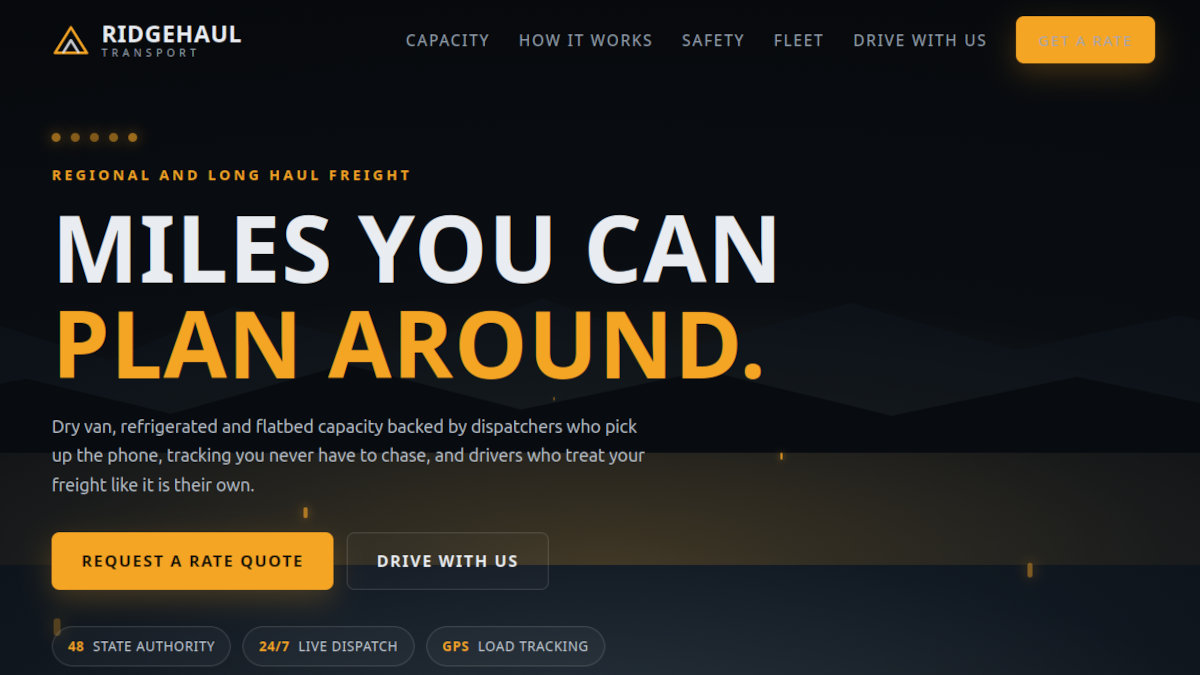
Websites for trucking companies and freight carriers.
A carrier is not a local business. Nobody searches "trucking company near me" and picks the closest one. Shippers and brokers check authority, insurance, equipment and lanes; drivers check home time and pay. So the search work on this site is about authority and recruiting, not the map, and the markup is shaped for that. Here is what a BizPinPro site for this trade carries, and why.
Why a carrier's site is built differently
Two audiences, neither of them local. A broker with a load in Roanoke wants to know in ten seconds whether the carrier has reefer capacity, 48-state authority and a dispatcher who answers. A driver wants to know the lanes, the iron and whether home time is real. The site is split for both from the first screen, and the quote form and the driver application are the two pages that matter.
Google reads the same split. The structured data says what kind of operation this is, with the USDOT and MC numbers as identifiers, a national area served rather than a town, and every equipment type listed, so when a safety department looks the company up the knowledge panel shows the operation instead of an empty card. The openings on the drivers page are marked up as job postings, which puts them in Google's jobs panel without a board fee.
Structured data for a carrier, not a shop
Schema markup is a block of data in the page head, written in JSON-LD. Schema.org has no type for a freight carrier (it has shops, dealers and movers, none of which fit), so the business is typed as a business with the specifics carried by the fields: the USDOT and MC numbers as identifiers, the area served as the whole country, the equipment and services listed one by one, and a dispatch contact marked as answered around the clock. The home base keeps its town so the company exists somewhere real, with no attempt to win a local map pack.
The shape, shortened
{
  "@type": "LocalBusiness",
  "name": "Ridgehaul Transport",
  "address": {
    "@type": "PostalAddress",
    "addressLocality": "Dublin",
    "addressRegion": "VA",
    "addressCountry": "US"
  },
  "areaServed": {
    "@type": "Country",
    "name": "United States"
  },
  "identifier": [
    {
      "@type": "PropertyValue",
      "propertyID": "USDOT",
      "value": "1234567"
    },
    {
      "@type": "PropertyValue",
      "propertyID": "MC",
      "value": "987654"
    }
  ],
  "contactPoint": {
    "@type": "ContactPoint",
    "contactType": "dispatch",
    "hoursAvailable": "Mo-Su 00:00-23:59"
  },
  "hasOfferCatalog": {
    "@type": "OfferCatalog",
    "itemListElement": [
      {
        "@type": "Offer",
        "itemOffered": {
          "@type": "Service",
          "name": "Dry Van"
        }
      },
      {
        "@type": "Offer",
        "itemOffered": {
          "@type": "Service",
          "name": "Refrigerated"
        }
      },
      {
        "@type": "Offer",
        "itemOffered": {
          "@type": "Service",
          "name": "Flatbed and Step Deck"
        }
      }
    ]
  }
}
The DOT and MC numbers are the two facts every broker and safety department checks first. Putting them in the markup, not only on the page, is what lets Google connect the company to them.
01
Driver recruiting that shows up in Google for Jobs
The openings on the drivers page are marked up as job postings: route type, home time, pay basis, the CDL required, and a real end date so a filled seat drops out of Google on its own. Drivers who search "CDL jobs home weekly Virginia" see the opening in the jobs panel with an apply button that lands on the site. No board fee.
02
Title, description and canonical address
The title tag leads with "dry van, reefer and flatbed carrier, 48 states," name second, because a broker searching for capacity types equipment and lanes, never a company name. The meta description says 48-state authority, live tracking, dispatch around the clock. The canonical tag keeps the copies of the page from splitting its ranking.
03
A share card that gets forwarded
Freight and drivers both come by referral: a broker forwarding the link to a shipper, a driver posting it in a trucking group. The Open Graph and Twitter card tags decide what that forwarded link shows: the iron, the name and what it hauls.
04
A sitemap that updates itself
The sitemap is generated by code from the pages that exist right now. Add a lane page or a new equipment type and it is in the list the same minute, with an honest change date.
05
llms.txt for the AI assistants
"Reefer carrier in Virginia that runs the Southeast." llms.txt hands the assistant the authority, the equipment, the lanes and the dispatch line. Its value is still debated and its cost is nothing.
06
Built for a dispatcher with six windows open
Accessibility here is practical: a rate request form whose fields announce themselves and tab in the right order, the moving highway in the hero stopped for anyone with reduced motion on, and the lane board readable as a plain list by a screen reader.
07
A rate request that reaches dispatch, not the spammers
Pickup, delivery, equipment, ready date, freight details, best contact. Seven checks between Send and the inbox, starting with a honeypot only bots fill. "Need a reefer out of Roanoke tomorrow, 42k lb, call me" goes straight through, and every delivered request is kept in the client portal.
08
Hosting, monitoring and a monthly report
The site lives on a server BizPinPro controls with nightly backups, an SSL certificate that renews itself, and a monitor. For a carrier the monthly report is less about the map and more about which pages are doing work: in a slow freight quarter the recruiting page often draws more visits than the quote page, and the report shows that shift month by month. Page weight is kept low for the cab on a truck stop's wifi.
Common questions
Why is a carrier not a local business for Google?
Because the customers are not local. A broker in Ohio books capacity in Virginia by equipment and lanes, not by distance. The structured data says the area served is the country, carries the DOT and MC numbers, and makes no attempt to win a local map pack, which a carrier does not need and would confuse Google about what it is.
Can the website help us hire drivers?
Yes, and it is the clearest payoff. Openings on the drivers page marked up as job postings are listed in Google's jobs panel, next to the paid boards, with an apply button that lands on your own page. The posting carries an end date, so a filled seat stops taking applications by itself.
What does a trucking website cost from BizPinPro?
Flat-rate hosting at a fixed monthly price, no contracts, and a one-time build. The pricing section on our homepage has the exact numbers, or contact us for a quote for your operation.
Can I see one?
Yes. Ridgehaul Transport is a fictional carrier built as a working example, with capacity, safety, fleet, drivers and quote sections, and a "Behind the scenes" section at the bottom that opens every piece described here, including the job posting markup.