Why It Exists
When someone pastes a link into a Facebook post or a group text, the app does not show the bare address. It fetches the page and builds a card: a picture, a title and a line of description. That card is what everyone in the thread sees, and it is what they decide to click or scroll past.
Facebook introduced Open Graph in 2010 so a page could say, in its own code, exactly what that card should contain. Every other platform that builds preview cards reads the same tags now, including LinkedIn, Slack, iMessage and most messaging apps. Twitter, now X, reads them too, with a small set of its own tags layered on top.
What It Looks Like
Open Graph tags sit in the head of the page, next to the title and the meta description, and are never visible to a person reading the page. A complete set for a small business homepage looks like this.
<meta property="og:site_name" content="Gable Exterior Cleaning">
<meta property="og:title" content="Pressure Washing in the New River Valley">
<meta property="og:description" content="Soft washing and pressure washing for homes in Blacksburg, Christiansburg and Radford.">
<meta property="og:url" content="https://example.com/">
<meta property="og:type" content="website">
<meta property="og:image" content="https://example.com/includes/og-image.jpg">
The image is the part that matters most and the part most often missing. It needs to be at least 1200 by 630 pixels, served from the site's own address, and chosen on purpose. For a pressure washing company that is the half-cleaned driveway. For a restaurant it is the plate. For a tow company it is the truck.
What Happens Without It
The app guesses. It may pick the first image it finds on the page, which is often a logo too small to read, a stock photo, or nothing at all, leaving a grey box. The title becomes whatever the page's title tag says, and the description becomes the first sentence the app can find, which is frequently a navigation label or a cookie notice.
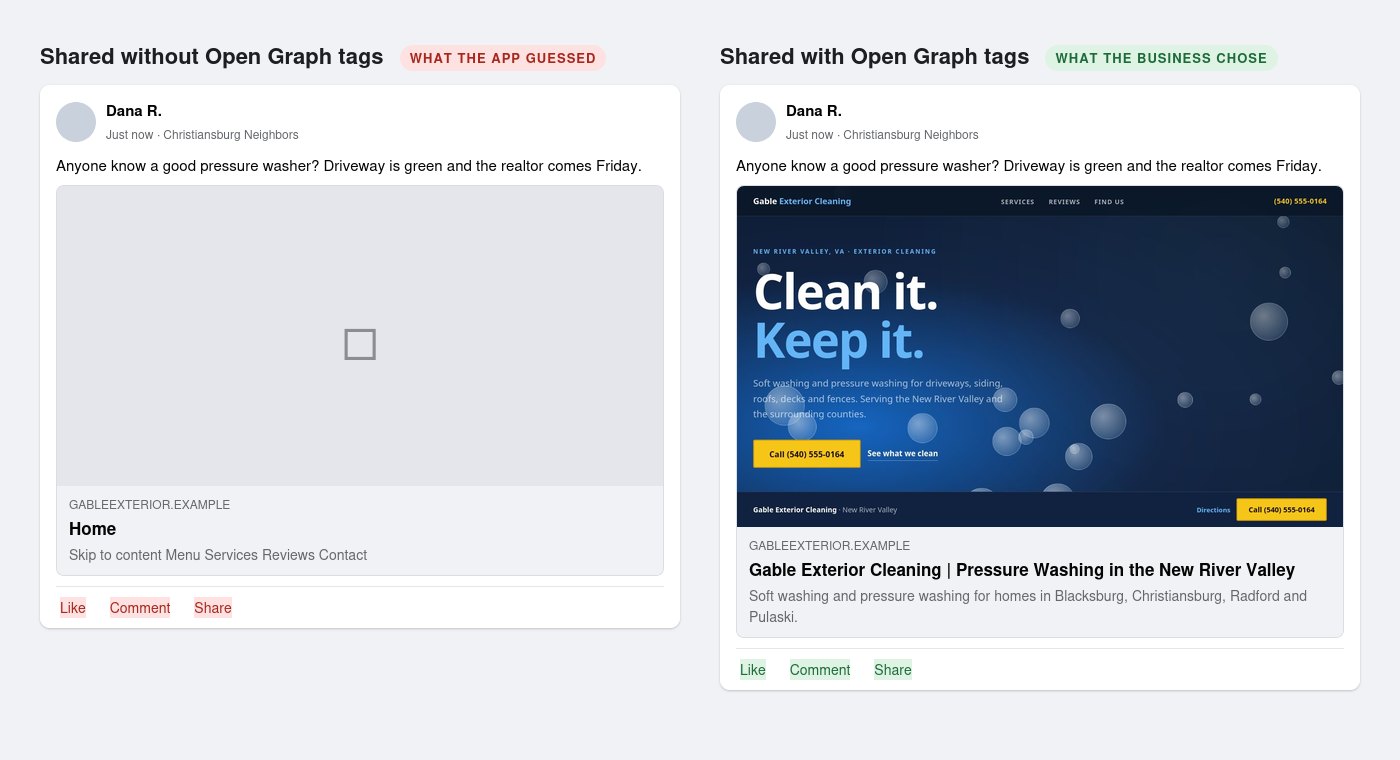
For a small business this is not a cosmetic problem. Most local businesses get the bulk of their new customers from a neighbor recommending them in a Facebook group or a text thread. The link that gets pasted into that thread is the advertisement. A link that shows a grey box and the word Home gets scrolled past. A link that shows the work and the name gets clicked.
How To Check It
Paste the website address into a Facebook post without publishing it and look at the card that appears. If the picture is wrong, missing, or the title reads like a file name, the tags are missing or wrong. Facebook's Sharing Debugger and LinkedIn's Post Inspector both show exactly what each platform read from the page and let the cached version be refreshed after a fix.
The Foundation Connection
Open Graph is part of the Verified Identity layer of the Digital Foundation. It is one of the places a business decides how it is presented instead of letting a platform decide for it. Every page on a well built site carries a complete set, with a fallback image for pages that have no photo of their own, so no share from any page ever goes out as a grey box.
It costs nothing after the first time it is set up, and it works every time a customer does the marketing for you.


