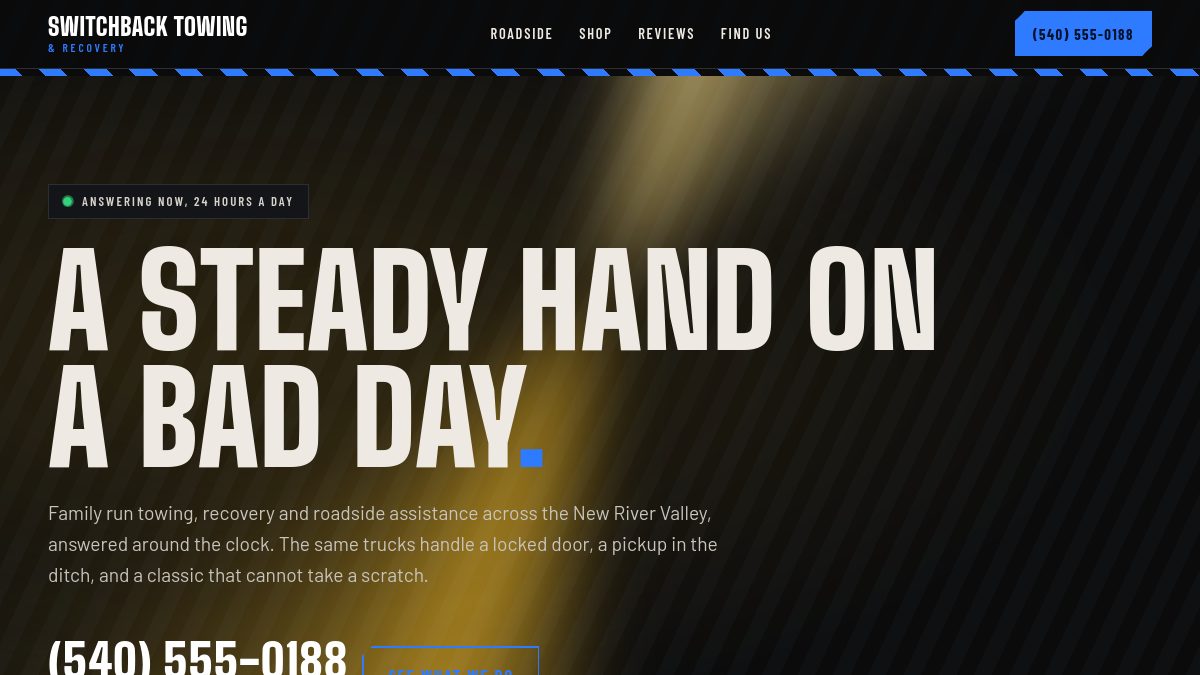
Websites for towing and recovery companies.
A tow company is a mobile business that works at the worst moment of someone's day. The person searching is on the shoulder, on a phone, and will call the first result that shows a number and "Open 24 hours." So the site has to get three facts to Google before anything else: the number, that it is answered right now, and which roads the trucks cover. Here is what a BizPinPro site for this trade carries, and why.
Why a tow company's site is built differently
Most of the people who will ever visit the site are in a hurry and holding a cracked phone. They are not reading about the company. They want a number they can tap and a reason to believe someone will answer. The hero is a phone number, the hours say twenty-four, and everything else on the page is for the second visit.
Google is the first visit. A tow company has no storefront customers come to, so the Business Profile hides the yard address and lists the area served, and the site's structured data says the same: counties or a highway corridor, hours open every day all day, and the phone first. A heavy recovery outfit lists the corridor by name, because a dispatcher three states away searches "heavy wrecker I-81 Virginia," not a town.
Structured data for a 24-hour mobile business
Schema markup is a block of data in the page head, written in JSON-LD. Schema.org has no towing type, so the business is typed as an automotive business and the nine services carry the specifics. The hours say open every day, all day, which is what lets Google print "Open 24 hours" under the name. The area served is the counties, or the corridor for heavy work. No street address: the yard is not a place customers visit, so the markup matches a Business Profile with the address hidden.
The shape, shortened
{
  "@type": "AutomotiveBusiness",
  "name": "Switchback Towing & Recovery",
  "telephone": "+15405550188",
  "address": {
    "@type": "PostalAddress",
    "addressRegion": "VA",
    "addressCountry": "US"
  },
  "areaServed": [
    "New River Valley, Virginia",
    "Montgomery County, VA",
    "Pulaski County, VA"
  ],
  "openingHoursSpecification": [
    {
      "@type": "OpeningHoursSpecification",
      "dayOfWeek": [
        "Monday",
        "Tuesday",
        "Wednesday",
        "Thursday",
        "Friday",
        "Saturday",
        "Sunday"
      ],
      "opens": "00:00",
      "closes": "23:59"
    }
  ],
  "hasOfferCatalog": {
    "@type": "OfferCatalog",
    "itemListElement": [
      {
        "@type": "Offer",
        "itemOffered": {
          "@type": "Service",
          "name": "Light & Medium Duty Towing"
        }
      },
      {
        "@type": "Offer",
        "itemOffered": {
          "@type": "Service",
          "name": "Recovery & Winch Outs"
        }
      },
      {
        "@type": "Offer",
        "itemOffered": {
          "@type": "Service",
          "name": "Accident Recovery"
        }
      }
    ]
  }
}
The phone number comes first in the markup for the same reason it comes first on the page: it is the number Google puts behind the call button on a phone.
01
Title, description and canonical address
The title tag leads with "24 hour towing" and the area, company name second, because the driver on the shoulder has never heard of the company. The meta description says lockouts, jump starts, winch outs and "call or text any hour." The canonical tag keeps the www and tracking-code copies of the page from splitting its ranking.
02
A share card that gets pasted at 11 pm
The share that matters is in a neighborhood group under "who do I call, car died on 460." The Open Graph and Twitter card tags decide what that pasted link shows: the truck, the name and the words 24 hours, before anyone clicks.
03
A sitemap that updates itself
The sitemap is generated by code from the pages that exist right now, with honest change dates. Add a page for accident recovery or a new service area and it is in the list the same minute.
04
llms.txt for the AI assistants
Someone asks an assistant "who tows near Christiansburg at night." llms.txt hands it a clean summary: 24 hours, the services, the counties, the number. Its value is still debated and its cost is nothing, so every site gets one.
05
Built for a shaken driver on a cracked phone
Accessibility on a towing site is practical: one obvious button, big enough for a thumb, announced as a phone number and not "click here"; a page that still works at 200 percent zoom; and a beacon light kept under the flash rate that can trigger a seizure.
06
A request form for the jobs that can wait
Equipment moves, long-distance transport, a car at the impound lot. The form posts through seven checks, starting with a honeypot only bots fill, and a short urgent message like "car dead on 460 by the Walmart" goes straight through. Every delivered message is kept in the owner's client portal.
07
Hosting, monitoring and a monthly report
The site lives on a server BizPinPro controls with nightly backups, an SSL certificate that renews itself, and a monitor that notices when it is down at 2 am. The monthly report shows calls from the profile by month next to the searches that drove them, so the owner knows whether "tow truck near me" or the company name is bringing the work.
08
Light enough to load on the shoulder of I-81
The visitor has one bar of signal. No page builder, no plugin stack, no tracking scripts: one file, the fonts and a photo of the truck. Page weight is the difference between the number appearing and the driver calling someone else.
Common questions
Should my towing website show the yard address?
Usually not. If customers do not come to the yard, hide the address on the Business Profile and list the counties or corridor served, and keep the website's structured data matching. If you release vehicles from the yard, keep the address on the profile and add office hours separate from the 24-hour dispatch line.
What should the first thing on the page be?
The phone number, as a tap-to-call button, with the words 24 hours next to it. Everything else is for the second visit. The person who needs you right now is not going to read about your history.
We work a highway corridor, not a town. Does that matter?
Yes. A heavy recovery company lists the corridor in its structured data and its copy, I-81 and US 460 by name, because the dispatcher searching for a wrecker is hundreds of miles away and searches by highway. A town-based service area would miss that search entirely.
Can I see one?
Two. Switchback Towing & Recovery is the light and medium duty version, and Draglink Towing & Recovery is the heavy recovery, corridor version. Both are fictional working builds with a "Behind the scenes" section at the bottom that opens every piece described here.