Websites for dog groomers.
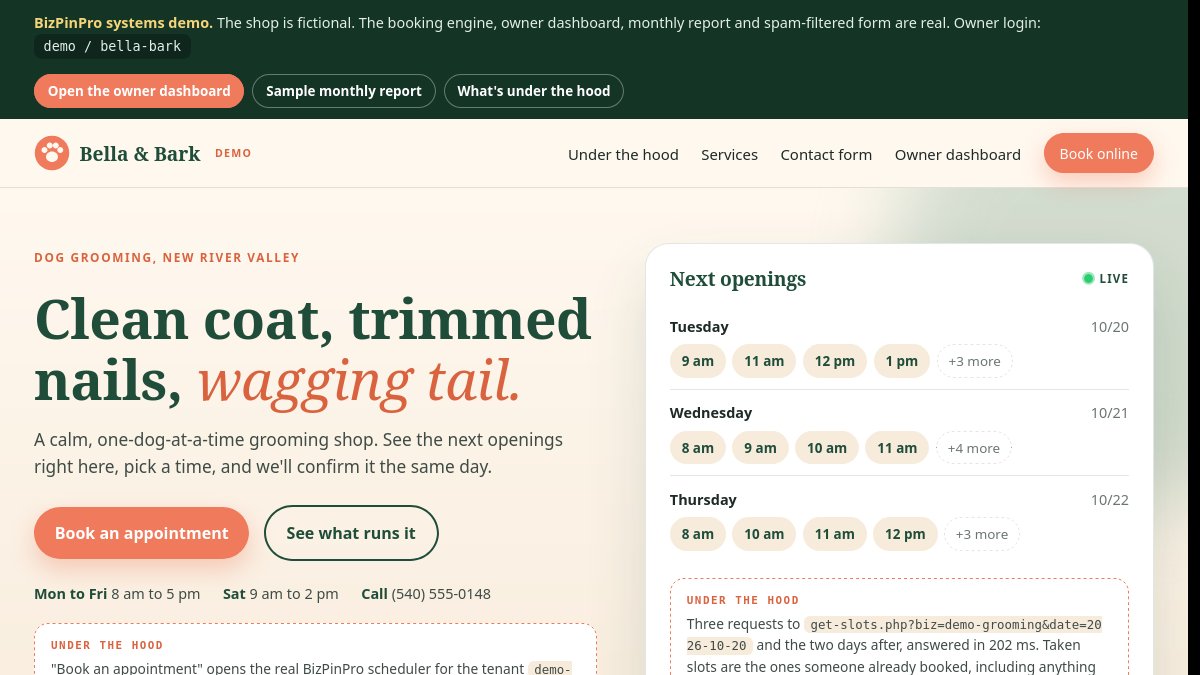
A groomer is a storefront business: the dog comes to you. So the markup carries the address and the hours, which is what puts the pin on the map, the directions button and "open now" on the profile, and a booking link rides along so Google can put a book button there too. The customer is a new dog owner searching "dog groomer near me," usually at night, and the site lets them see the next openings and book one without a phone call. Here is what a BizPinPro site for this trade carries, and why.
Why a groomer's site is built differently
The person booking is a dog owner with a specific worry: a nervous dog, a matted coat, a first groom. They are not comparing groomers on design. They want to know the shop is calm, see a time that works, and book it at 10 pm when they remembered. A site that only says "call us" loses that booking to the one that shows next Saturday open.
Google needs the storefront facts. The Business Profile carries the address, and the site's structured data matches it with hours, the services and a booking action, so the map pin, "open now" and the book button all come from one place. Schema.org has no grooming type, so the shop is typed as a local business with the services spelled out one by one.
Structured data for a storefront with online booking
Schema markup is a block of data in the page head, written in JSON-LD. Schema.org has no type for a groomer (the pet type is retail, the animal type is for shelters), so the shop is typed as a local business with the services listed one by one. The street address and coordinates are in it, the hours match the scheduler, and a booking action points at the booking page, which is what Google uses to put a book button on the profile.
The shape, shortened
{
  "@type": "LocalBusiness",
  "name": "Bella & Bark Grooming",
  "telephone": "+15405550148",
  "address": {
    "@type": "PostalAddress",
    "streetAddress": "(from the Google Business Profile)",
    "addressLocality": "Christiansburg",
    "addressRegion": "VA",
    "addressCountry": "US"
  },
  "openingHoursSpecification": [
    {
      "@type": "OpeningHoursSpecification",
      "dayOfWeek": [
        "Monday",
        "Tuesday",
        "Wednesday",
        "Thursday",
        "Friday"
      ],
      "opens": "08:00",
      "closes": "17:00"
    }
  ],
  "hasOfferCatalog": {
    "@type": "OfferCatalog",
    "itemListElement": [
      {
        "@type": "Offer",
        "itemOffered": {
          "@type": "Service",
          "name": "Bath & Brush"
        }
      },
      {
        "@type": "Offer",
        "itemOffered": {
          "@type": "Service",
          "name": "Full Groom"
        }
      },
      {
        "@type": "Offer",
        "itemOffered": {
          "@type": "Service",
          "name": "De-shedding Treatment"
        }
      }
    ]
  },
  "potentialAction": {
    "@type": "ReserveAction",
    "target": {
      "@type": "EntryPoint",
      "urlTemplate": "https://bellaandbark.example/book"
    }
  }
}
The services in the markup come from the same list that runs the booking page. Add one in the owner dashboard and both change.
01
Title, description and canonical address
The title tag leads with "dog grooming" and the valley, name second, because a new dog owner searches for the service, not the shop. The meta description names the services and says book online. The canonical tag keeps the copies of the page from splitting its ranking.
02
A share card that is the after photo
The after photo of somebody's doodle in a neighborhood group is the ad, and the Open Graph and Twitter card tags decide what the link under it shows: the dog, the name and "book online."
03
A sitemap that updates itself
The sitemap is generated by code from the pages that exist right now. The booking page and the service list come from the scheduler, so when the groomer adds a service in the dashboard, the page for it is in the sitemap the same minute.
04
llms.txt for the AI assistants
"Dog groomer near Blacksburg that takes nervous dogs." llms.txt hands the assistant the hours, the services with starting prices, and the booking link. Its value is still debated and its cost is nothing.
05
Built so everyone can use it
Accessibility is built in: the live openings are real links a screen reader reads as "9 am, link," every form field has a label, the booking page is built to the same rules, and the page works at 200 percent zoom for the owner booking from a phone with the text size turned up.
06
A contact form that reaches you, not the spammers
Name, phone, the dog's name and breed, size, the service they are thinking of, anything to know. Seven checks between Send and the inbox, starting with a honeypot only bots fill. "Can you fit a nail trim in today" goes straight through, and every delivered message is kept in the client portal.
07
Online booking the groomer approves
The booking engine offers only the times the calendar has free. The request lands on the owner's dashboard for a yes, the customer gets a status link, and the slot disappears from the page. Hours, closed days, the service list and the cancellation policy are the groomer's to change, no developer needed. The example site opens the dashboard with a demo login.
08
Hosting, monitoring and a monthly report
The site lives on a server BizPinPro controls with nightly backups, an SSL certificate that renews itself, and a monitor. The monthly report shows how many of the month's bookings started from a Google search versus the shop's name, which is the number that says whether the marketing is working or the regulars are. Page weight is kept low so the page loads in a parking lot.
Common questions
Does online booking mean customers book themselves into my day?
No. They request a time from the ones your calendar has free, and nothing is confirmed until you approve it from the dashboard. The customer gets a status link that changes when you say yes, and can cancel from it. One dog on the table at a time stays your rule.
Why does the schema say LocalBusiness instead of a grooming type?
Because schema.org has none. The pet type is for retail stores and the animal type is for shelters; neither fits a grooming service. LocalBusiness with the services spelled out one by one is the honest, correct markup, and it is what the Google Business Profile category pairs with.
What does a grooming website cost from BizPinPro?
Flat-rate hosting at a fixed monthly price, no contracts, and a one-time build. The booking engine is included where the shop wants it. The pricing section on our homepage has the exact numbers, or contact us for a quote.
Can I see one?
Yes. Bella & Bark Grooming is a fictional shop built as a working example, with a live booking engine, a demo owner login printed on the page, a sample monthly report, and a "Behind the scenes" section that opens every piece described here.